The Illuminati
Conspiracy, History, and the Secret Order That Never Died
Chapter 1 — The founding (May 1, 1776)
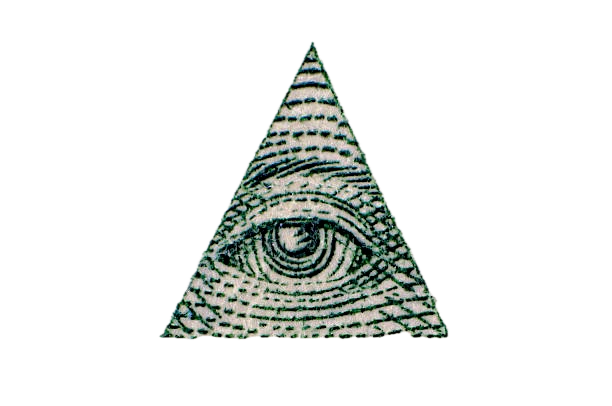
On May 1st, 1776, five men gathered in Ingolstadt, Bavaria, led by 28-year-old Adam Weishaupt, a professor of canon law. They founded a secret society first called the Order of Perfectabilists, quickly renamed the Order of the Illuminati. Their symbols were the Owl of Minerva and a dot within a circle representing an all-seeing eye — not of God, but of mysterious "unknown superiors."
The society's stated goals included opposing superstition, religious influence over public life, and abuses of state power. Weishaupt's vision was nothing less than a world revolution resulting in a universal republic — a New World Order. By 1778, membership had grown to twenty-seven, grouped into five lodges — mostly students, little more than boys.
Chapter 2 — Cultural footprint
Over two centuries later, the Illuminati name is deeply embedded in popular culture as the generic term for any conspiratorial group bent on world domination. People analyze Super Bowl ads for hidden Illuminati symbols, and the concept has been parodied in Taco Bell commercials. The Bavarian Illuminati have spawned a massive cottage industry of conspiracy theory.
The Illuminati were very much a creature of the 18th century Enlightenment — a time mostly identified with the flowering of reason and science, but which also saw an explosion of interest in mysticism and the occult.
Chapter 3 — Origins of the term & Weishaupt's innovations
The term "Illuminati" is not new — in the classical age, any initiate of a mystery cult was considered an illuminatus. Weishaupt's key original contribution was organization through secrecy and conspiracy. He decreed: "The great strength of our order lies in its concealment. Let it never appear in any place in its own name, but always covered by another name."
A fascinating contradiction lay at the heart of Illuminism. Weishaupt's approach was a degradation of Kant's famous principle — that Enlightenment was a man's passage out of his self-imposed immaturity by daring to use his own reason. Yet Weishaupt's order prescribed in great detail everything its members should think and do.
Chapter 4 — How exposure actually helped them
Paradoxically, exposure may have been the best thing that ever happened to the Illuminati — there is no such thing as bad publicity. The order's name spread far and wide, and as many people were intrigued as repulsed. Some even argue Weishaupt deliberately blew the order's cover as part of his plan.
The discovery of the order's documents came in 1786 when police raided the private residence of Xavier Zwack in Landshut, finding secret order materials including the cipher of the order, its calendar, code names for geographical locations, and the full list of members.
Chapter 5 — Who was Adam Weishaupt?
His full name was Johann Adam Joseph Weishaupt. He was not Jewish, as some have claimed, nor a Jesuit priest. He became the first non-Jesuit chair of canon law at Ingolstadt University in nearly a century. His Jesuit instructors were noted for casuistry — the art of using rational argument to justify dubious conclusions.
The Jesuits were effectively a secret society within the Catholic Church, fighting enemies by all means including political conspiracy and even assassination. In 1773, Pope Clement XIV abolished the Jesuits, giving Weishaupt his opportunity. His leadership of the Illuminati directly mimicked the autocratic power of the Jesuit Superior General.
Chapter 6 — Internal structure: members were not equal or free
Despite promising freedom and equality, the Illuminati internally were neither. The society was organized into three main classes, progressing from Novice to higher mystery grades unknown to ordinary members. Novices were under complete control of their "insinuator," told what to read and think, and required to keep daily accounts of their every thought and action.
No "religionist" — anyone retaining any fragment of old religious belief — could be admitted to the higher ranks. Patriotism was equally forbidden. Ordinary morality was discarded entirely — assassinations, treasons, and perjuries were not crimes if done on command of superiors for the good of the order.
Chapter 7 — The Illuminati in practice
Researchers identify about 450 confirmed Illuminati, with estimates ranging up to 2,000. Known members came almost exclusively from the intelligentsia: lawyers, academics, physicians, writers, and theologians. Johann Wolfgang von Goethe, author of Faust, was among them, as was Duke Carl August of Saxe-Weimar.
Under pressure from the Church, Karl Theodore of Bavaria banned the Illuminati in 1784, 1785, 1787, and 1790 — the repeated banning itself confirming how difficult suppression was. Weishaupt slipped away to Gotha, protected by its Illuminatus prince.
Chapter 8 — Other Illuminati cults throughout history
The term goes back to the mystery cults of the Roman Empire. The Roshaniyah ("Illuminated Ones") appeared in what is now Afghanistan in the 1500s, preaching the overthrow of the Mughal Emperor and the creation of a new world order. The Alumbrados of Spain were first mentioned in 1492, suspected of being a survival of the Cathars, banned by the Inquisition in 1525.
After the suppression of Weishaupt's order, the title "Illuminati" was also given to the French Martinists, founded in 1754. By 1790, Martinism had spread to Russia, with both strains including elements of Kabbalism and Christian mysticism.
Chapter 9 — The Illuminati in literature, pop culture & conspiracy theory
Mary Shelley's Frankenstein (1818) is set in Weishaupt's hometown of Ingolstadt — some see this as an allegory for his creation, a monster that escaped his control. The order appears in Tolstoy's War and Peace, and has been referenced by Umberto Eco, Dan Brown, and the Marvel Universe.
As early as 1797, the group was credited with instigating the French Revolution. Later claims connected them to the Russian Revolution of 1917 and even the assassination of President John F. Kennedy in 1963. In the 1990s, British conspiracist David Icke transformed the Illuminati into shape-shifting lizard people from outer space.